
A furious Jackson goes to see the fortune-teller to berate her, but she already knew
of his friend's fate and confesses that she lied to him to make his last hours happy ones. She then offers
to read Jackson's future. What she sees stupefies them both: none of this is real. This is a dream
Jackson is having, and his subconscious is trying to warn him, because he's fallen asleep at the wheel of a car,
while driving to meet his lover! The car crashes. Jackson survives, but finds himself on a dark, lonely country
road. Stumbling along, he finds a private clinic where he thinks he can get help. He blacks out and,
when he awakens, he finds himself strapped on an operating table, at the mercy of the clinic's lunatic owner, the
terrifying Doctor Despair. A climate of surreal terror sets in as Despair claims to hate Jackson because his
lover is also Despair's head nurse and girl friend. With sadistic pleasure, Despair mutilates the helpless
Jackson by blinding him, cutting out his tongue, then performing brain surgery to alter his memories. When Jackson wakes up again, he learns that his mutilations are the result of the
deadly car crash, his partial amnesia a post-traumatic shock, and that the kindly Doctor Despair actually saved
his life. Or did he?… As Jackson is introduced to the other, deformed and disturbed residents of the clinic,
he starts to suspect that the earlier scenes of horror were very real, that Dr. Despair is truly mad, and that
he is using him as a pawn in a demented scheme of revenge against his wife, Helen, who once betrayed him.
No one knows what Dr. Despair's plan is, other than that it is truly abominable and will do worse to Helen than
merely kill her. As per Dr. Despair's plan, Jackson slowly falls in love with Helen -- something that
will make her agony even more unendurable. He desperately tries to divine what monstrous scheme the Doctor
has hatched that will result in Helen's doom, but in Dr. Despair's asylum, no one is ever sure of what is a lie
and what is the awful truth. Ultimately, Dr. Despair succeeds in carrying out his ghastly scheme. Jackson
succeeds in getting revenge and killing Dr. Despair. But the story is far from over as Jackson still has
to discover who he really is, and understand the real meaning behind the abominable events that have taken place
in Dr. Despair's clinic… The ultimate revelation, when it comes, is imbued with deadly, nightmarish logic.
As the film ends, all the pieces of the story fit together in a pattern of inescapable doom. The works of Marc Agapit are considered classics of French horror literature. Twelve
of his most successful novels (including La Bête Immonde) were adapted into a series of graphic novels entitled "Hallucinations" in the early 1970s. His books were reprinted in new editions in the late 1970s. An "omnibus"
edition of several of his best novels (again including La Bête Immonde) was released in 1997.


Buy the Book:
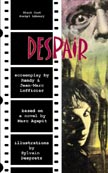
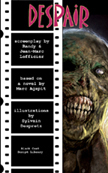
DESPAIR: THE SCREENPLAY by Randy &
Jean-Marc Lofficier based on a novel by Marc Agapit; illustrated by Sylvain Despretz;
Black Coat Press, $15.95, 5x8 trade pb, 160 pages. ISBN: 1-932983-06-6. A macabre horror story based on a classic
French horror novel, illustrated by one of the designers of Gladiator.
Story Summary:
A man named Jackson meets a friend who tells him that a fortune-teller has (seemingly accurately) predicted a wonderful
future for him. The unbelieving Jackson dismisses the predictions, stating that his friend could just as
readily be run over by a bus. Which is exactly what happens after the friend walks out in the street.

Marc Agapit:
Adrien Sobra (1897-1985), a French English
teacher, was a mainstream novelist who had published a few novels and thrillers before turning to writing popular
horror fiction under the pseudonym of "Marc Agapit"
in the 1950s and 1960s. As Agapit, Sobra wrote forty-three novels for the popular horror imprint of Editions Fleuve Noir, one of the largest French publishers, and quickly became one of their best-selling and most
acclaimed authors. Agapit used the supernatural sparsely, his catalog of horrors being somewhat more akin to a
Ruth Rendell rewritten by the Grand-Guignol. He delighted in throwing a light on the perversity of the human soul,
showing sordid, lonely, ordinary people ravaged by time, slowly sinking into madness. His heroes often came from
cursed families. They exhibited an unhealthy sexuality, and may even have been afflicted with physical handicaps,
such as the doomed protagonist of La Bête Immonde
(1959), now the basis for the motion picture Despair,
whose tragic hero is blind. Agapit's protagonists were sometimes young boys who became natural preys for evil females,
or innocently trafficked with the most monstrous, unnatural creatures, as in his classic Greffe
Mortelle (1958), which was praised by Jean Cocteau, the renowned author of the immortal Beauty and the Beast.